|
Introduction
The students at Amisted Elementary School, Kennewick WA, are preparing a virtual time capsule to pass on something from our times to an unknown future generation. Deciding what to put into such a capsule, as well as what form such a capsule should take, will be challenging. This essay is an adaptation of a multimedia presentation I made to the class sharing some ideas taken from my own work as an artist, art historian and collector, to get the students thinking about some basic issues of cultural value, identity, and preservation. Philip E. Harding - March 24, 1997 |
||
|
Cultural Memory
How do we determine meaning? How do we measure value? What do we do with those objects, places, and ideas that are important to us - both as individuals and as a civilization - so that their meaning and value is maintained? The two dolls on the right were purchased in Nairobi, Kenya. Each reveals something different about the culture and the motivations of craftsmen. The one on the left is a true ethnic art. It was made by a member of the Turkana Tribe from Northern Kenya, and shows a girl in traditional Turkana dress who has reached the age where she is now old enough to be married. The style is very abstract. The face is flat with angular, mask-like features showing no expression of individuality or emotion. The remaining arm is very thin and was never given a hand. In contrast the breasts, belly and hips have been emphasized because these features are important to giving birth and raising children. The chances are good that this doll was made with a specific girl in mind - perhaps by a member of her own family - not simply as a toy to be played with but as a sort of fertility figure. At some point, the girl grew up and the doll was no longer wanted. The doll may well have had its arm deliberately broken off to release its spirit or magical powers before being sold to a souvenir dealer. Eventually it reached the streets of Nairobi where it was sold to me. |
Two Kenya dolls, left - ethnic, right - tourist |
|
|
The figure on the right was also purchased on the streets of Nairobi, but it is not possible to determine which tribe or region of Kenya its craftsman came from. This is tourist art. It is done in a more modern, more realistic style. It presents a caricature of an African woman carrying a pot on her head. While her arms are also thin in proportion to her figure, this artist has not emphasized the woman's breasts and belly since this would be considered immodest to most modern Western viewers. The craftsman has carved the figure out of ebony because tourists will pay more for ebony. He has given the work a flat base so that it can stand upright on a tourist's table or fireplace mantel. In short, the figure on the right was made in order to make money from tourists and expresses little or nothing of the artist's traditional cultural values. So what are these two figures worth and how is their value measured? If measured in dollars as charged by Nairobi street vendors in the early 1980's then they are worth about the same - around ten US dollars. But if we measure them for their ability to express cultural meaning and the values of those who created them, then the Turkana doll is clearly more valuable. From a cultural standpoint it is a truer, more honest work of art. |
||
|
While I was in Kenya my father and I were invited to visit a clan of the Massai tribe in Southwest Kenya. This clan lived so far out in the African bush that they had spent days clearing a path just so our truck could reach their village. When we met the village elders under a flame tree, the oldest member of the tribe gave my father a stick. All Massai elders carry such sticks, just as their warriors carry spears. Therefore, in giving a stick to my father, they were embracing him as an honorary Elder in their clan. So how much is this stick worth? To talk about it in terms of dollars is meaningless. One might sooner ask, "what is the value of a Massai Elder?" This simple stick could properly be called "priceless." An object does not become priceless simply because it is rare or old or made by a famous person. An object is priceless because it has certain associations which give meaning and value that cannot be measured in dollars. These associations may be personal or something a whole nation or culture values. |
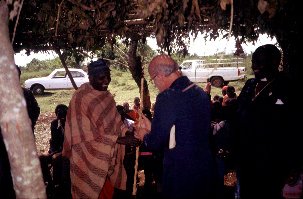
Massai Elders presenting a stick to my father. |

|
| Just because something has associations which make it priceless does not mean people will not attempt to put a price on it. We do this today with things owned by famous people. The string of fake pearls worn by Jacqueline Kennedy Onassis in the picture above, recently sold at auction for $211,500. If they had been owned by anyone else, they might have been worth less than $20.00. To the people bidding at the auction, these false pearls represented a moment in time - an intimate piece of history for which $211,500 seem a reasonable price to pay. |
Jaqueline Kennedy with faux pearls. |
|
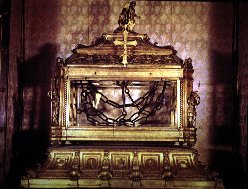
| Once we decide something is valuable, meaningful, or even priceless, what are we to do with it? We don't want everything falling into the hands of private collectors. If the object is a work of art or an object of rare historic value, it might be put in a museum. If it has religious or spiritual significance, it might be placed in a reliquary such as the Chains of Saint Peter, held in the Church of Saint Peter in Chains, in Rome. |
Reliquary containing the Chains of Saint Peter |
|
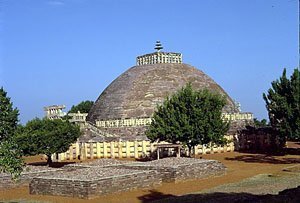
| Not all rare and priceless objects are suitable for so visible a display as the Chains of Saint Peter. In India, when the Buddha died in the 5th century BC, his body was cremated. So what do you do with Buddha ashes? Rare and priceless holy relics though they might be to the Buddhist, they could hardly put them on display. Instead his disciples divided them up and carried them to different parts of India where they placed them within stupas. Stupas are a form of reliquary unique to Buddhists and are designed to contain the relics of a saint or holy man. Stupas take many forms and continue to be built by Buddhists around the world to this day. One of the earliest and most famous that we know of is the Great Stupa of Sanchi. This stupa is in the shape of a solid dome representing the universe and is surrounded by four gates marking off the four directions. While this stupa was built some five hundred years after the Buddha's death, it was probably built over an earlier stupa that actually contained Buddha ashes. When pilgrims visit Sanchi and walk around the stupa, they are symbolically walking around the universe and the Buddha which is at its center. |
The Great Stupa of Sanchi |
|
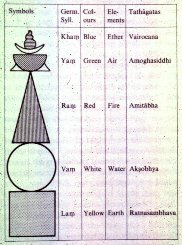
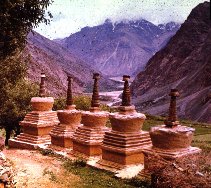
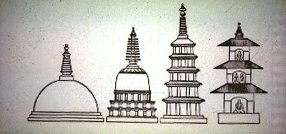
| In Tibet when a Buddhist saint dies, his ashes may also be placed in a stupa. The thing that makes a Tibetan stupa different is that the universe is not symbolised by a dome, but by shapes and colors that represent the elements of the universe. As Buddhism spread through China, Korea and Japan, the form of stupas evolved, becoming increasingly vertical in design until resulting in the multistoried pagodas found in those countries today. |
Symbolism of Tibetan stupa
|
Tibetan
Stupas
The evolution of stupas into pagodas |
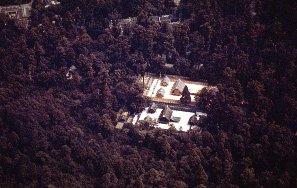
| Some reliquaries and shrines contain artifacts whose origins reach back into mythic times. According to Japanese mythology the Sun-Goddess Amaterasu, after being offended by another god, retreated to a cave and plunged the world into darkness. Some of the other gods then set up a tree outside the cave and hung in it a sacred mirror "cast in the heavens by the eight million deities." The gods then began to sing and dance, and when Amaterasu looked out to see what the excitement was, she saw the brilliant shining light of her own reflection. Curious to know who this new shining god was, she emerged from the cave, only to realize it was her own image reflected in the sacred mirror. Later Amaterasu gave the mirror, together with a sacred jewel and a sword, to her grandchild , Ninigi no Mikoto, as three symbols of God-bestowed authority, to take with him when he descended to earth to rule Japan. These three gifts became Japan's imperial regalia handed down for generations from one emperor to the next. According to tradition, in the fifth century, Japan's tenth emperor had the mirror taken to a place called Ise to be enshrined at a complex dedicated to Amaterasu where it remains to this day. | ||
Ise - aerial view |
Ise - ground level view |
|
|
So how does one venerate a god, or the gift of a god, that is a symbol of an imperial clan? At the Naiku, or inner shrine at Ise, the mirror is placed in a wooden container shaped like a boat, inside a raised floor sanctuary, surrounded by four concentric fences. Only priests who have ritually purified themselves may, on special occasions, enter the compound. What is perhaps most interesting about the shrines of Ise is that at the Naiku (inner shrine), the Geku (outer shrine), and several of the subsidiary shrines, there are two identical sites that sit side by side. Every twenty years these shrines are completely rebuilt in every detail on their adjacent sites. The holy artifacts are then moved to the new buildings and the old shrines are taken down. This practice has gone on every 20 years since the 7th Century and has helped to preserve a living example of early Japanese architecture. Perhaps more important, the rebuilding allows each new generation of Japanese people to reconnect with their own ancient traditions in a way that simply visiting the shrine would not. It enables them to become part of their history and to help pass it on to another generation. If the purpose of a shrine or reliquary is not simply to set aside an object of value, but to pass on some values and traditions for future generations to remember, then the Grand Shrines of Ise has succeeded. |
||
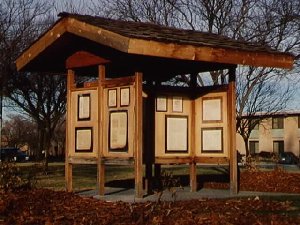
| Objects venerated in shrines need not be ancient or religious. What is most important is that they remind us of our past and the objects or ideas that we hold to be important. In public parks, schools, and libraries around the country, we have placed "Freedom shrines" which contain reproductions of the Declaration of Independence, the Constitution of the United States, the Bill of Rights and other documents important to American freedoms. These shrines don't actually venerate the documents themselves, but rather venerate and preserve the ideas contained within them. If we had rolled these documents up and placed them in a jeweled box, their significance would have been lost. |
Freedom shrine |
|
|
Throughout art and architecture history we see that many cultures don't simply
set aside objects for veneration but ideas as well. Recall the stupa structures
we saw earlier. While they may contain the relics of a saint their outer
form is also significant -- preserving the builder's ideas about the nature
of the universe.
Similarly, Hindus built temples that also represent the universe. It is believed that at the center of the universe is the mythical mount Meru, which is home to the gods. Therefore, over the sanctuary of every Hindu temple, towers a model of this mythic mountain. |
Hindu Temple |
|
|
The image of a mountain as home to the gods is a form reflected in the
architecture of many cultures. We see this idea in ancient Greece where the
Greeks believed the gods lived on Mount Olympus. The Greeks the built temples
for their gods high on a hilltop overlooking the people living below.
During the Middle Ages, builders designed cathedrals combining idea of the "New Jerusalem," or city of heaven, as described in the Book of Revelation, and the idea of Noah's Ark. The word "nave" which is used to describe the central space of the sanctuary, comes from the same Latin word as our word "navy" and suggests the cathedral was an ark or ship for transporting souls to heaven. |
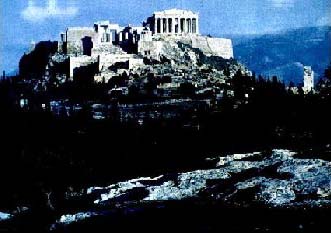
Athenian Acropolis |
|
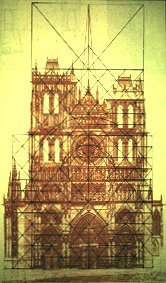
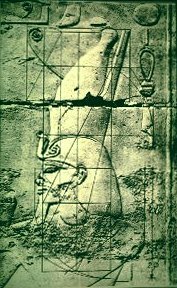
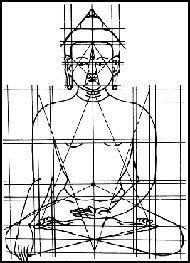
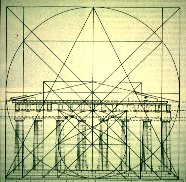
| The use of geometry in sacred architecture around the world also reveals a cultures belief in the order of the universe. Geometry is absolute, eternal and unchanging. Hence, it has been used by many religions to express what is eternal and unchanging. From temples and cathedrals to the proportions given to pictures of gods and saints, the use of geometry and particular geometric forms in art and architecture is fairly universal. | ||
Gothic Facade geometry |
Egyptian Pharaoh |
Geometry of Buddhist icon |
Geometry of Greek temple |
Geometry of Hindu temple plan |
|
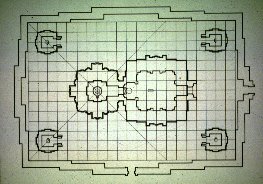
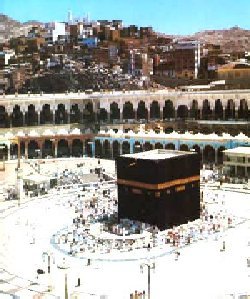
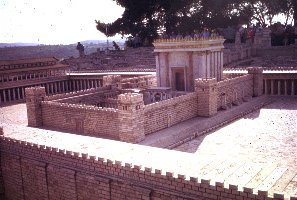
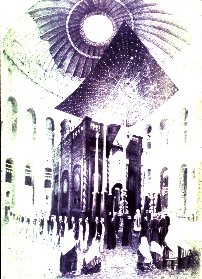
| Consider the use of the form of a cube. At the center of Mecca, toward which all Islamic Mosques in the world face, and toward which every Moslem faces when praying, there is a cube-shaped structure called the Ka'bah stone. Similarly, the sanctuary of all Hindu temples, directly under the towering form of a mountain, is in the form of a simple cube. The Holy of Holies in both the old Jewish tabernacle and the Jewish temple, was in the shape of a cube. In the church of the Holy Sepulchre in Jerusalem, a cubical sanctuary, with a semi-circular apse at its rear, sits under the main dome. Why a cube? This is a complex question whose answer varies whither one is asking an ancient Hindu architect, a Sufi mystic, a modern Sunni Moslem, or a Christian. It has been variously be used to symbolize the earth, man (in the abstract sense), and the ideal order of heaven on earth. A cube is a perfect geometric idea. Humans cannot build a perfect cube in the physical world, but by coming close to it, the mind can be directed beyond the physical world. | ||
The Ka'bah in Mecca |
Herod's temple
|
|
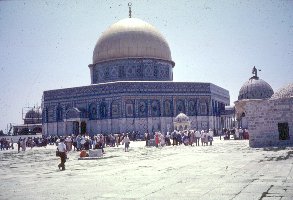
| Sometimes it is neither an object nor an idea that is venerated but a place, and this can be the root of some of the greatest cultural conflicts. On the temple mount in Jerusalem there once stood the Jewish temple. The temple was destroyed by Romans and is now the site for the Islamic Dome of the Rock. Today there are some orthodox Jews who think the temple should be rebuilt, but Moslems are not likely to let that happen without a fight. People from both religions regard the Temple Mount as holy ground, and both feel strongly about what should be built there. For each, their cultural histories, their religious values, even their very relationship with God, is believed to be at stake. Some of the people from both sides will not hesitate to fight, to kill and to die for their cause. How can each of these people preserve what they hold to be of priceless value when it conflicts with the values of the other? How can they live in peace? | ||
| Even within exclusively Christian holy sites there is conflict. The church of the Holy Sepulchre, in Jerusalem, is built where it is believed Christ was crucified, buried and rose from the dead. For many Christians this place is holy ground, and is venerated in much the same way relics are venerated in other parts of the world. Unfortunately, even though it is claimed holy by only one religion, there are nine different denominations there who fight over control of the site and disagree about virtually everything that takes place there. The recent and long overdue renovation of the dome had been delayed for decades because the different denominations could not agree how it should be done. The place even once had to be occupied by Israeli police because members of one denomination stoned the members of another. |
Church of The Holy Sepulchre |
|
|
When I visited Israel on a tour in 1983, my own sense of values was assaulted. Our bus took us past troops, tanks, prisons and mine fields. At the sea of Galilee we stayed in a luxury tourist hotel surrounded by high barbed wire fences. Where the fences met the sea, there were piles of broken concrete and coils of barbed wire entering the water. This was not the image of the Holy Land I had developed as I listened to my father's sermons as a child. Who do I blame? Many people in Israel blame each other. I have to blame myself -- my own expectations and desires. My trip to the Holy Land in search of meaning and value made me, and my tourist dollars for which this hotel was built, a pawn in someone else's conflict. Today when looking at objects of art, when looking at art history, and particularly when creating art objects of my own, I must not only consider the meaning and value it has for me, but I have to remember that other people's values are often quite different. Deciding what is meaningful and valuable, and then working to preserve or advance those values, often involves careful consideration and negotiation.
|
||